Why Group Nesting Costs Density — and How Pressria Bridge Recovers It
A print shop running dozens of small orders a day quietly wants two things at once: tight material usage, and parts that stay sorted by order after cutting. Most nesting tools make you pick one.
This post explains why that tradeoff exists — the geometry underneath it — and how Pressria Bridge (PB) is built to avoid choosing.
Two ways to nest a multi-order sheet
When many different designs land on one sheet, a nesting engine can take one of two routes:
- Scatter everything. Treat every part as independent and pack by true shape for maximum density. The packing is tight, but one customer's parts end up spread across the whole sheet. After cutting, an operator has to hunt them down and re-sort by order.
- Keep orders grouped. Bundle each order's parts into a block, then place the blocks. Sorting after cutting is trivial — but, as we'll see, density drops.
Some software automates neither step: you select and group parts by hand before nesting. The mechanism differs, but the geometry of the grouped case is identical.
- Scatter all parts — maximum density, but orders are scattered → manual post-cut sorting
- Manual sealed groups — orders stay sortable, but the blocks pack loosely → density lost
- PB: auto-group + gap-fill — sortable and density recovered, in one automated pass
Why a sealed group wastes material
Once you lock a set of parts into a fixed group, the engine can't move those parts independently anymore. It has to place the whole group as a single rigid unit, defined by the group's outer envelope — its silhouette, or in the simplest tools, its bounding rectangle. Two forces then work against you, both well established in packing theory.
1. Envelope waste. Reviews of two-dimensional irregular packing point out that when shapes are wrapped in an enclosing (envelope) polygon and that envelope is what gets positioned, density falls sharply, because everything between the real contour and the envelope is dead space. A block of irregular keychains has a ragged silhouette, and the concavities along its edges can't be reused by neighbouring blocks.
2. Lost degrees of freedom. Nesting is an optimization problem. Normally each part contributes its own position and rotation as free variables — and dense packing comes precisely from exploiting that freedom: sliding a small circle into the concave curve of a larger character, interlocking two L-shapes. Freezing parts into a group deletes those variables. Adding constraints to an optimization can never raise the best achievable result; it almost always lowers it. So a grouped layout's ceiling sits strictly below the same parts placed freely.
That's what shows up on the bench as "big blocks pack badly." It isn't an implementation bug — it's the geometry.
The clustering caveat — read this before you quote the theory
If you dig into nesting research, you'll find clustering described as a state-of-the-art technique that raises density — the opposite of what we just said. Both statements are true, because they describe different things.
The clustering in the literature — for example, the pairwise clustering inside Elkeran's Guided Cuckoo Search — groups complementary shapes. The algorithm automatically finds two pieces whose contours fit together, a convex bump matching a concave notch, and treats that matched pair as a unit. Density goes up because the combined shape tiles better than the pieces did separately.
That is not the same as grouping identical parts for sorting. Sorting-driven grouping bundles the same shape over and over, producing a ragged, poorly-tiling block. Density-driven clustering bundles different, complementary shapes specifically because they tile well.
So the rule is: clustering for shape-fit helps density; grouping for order-sorting hurts it. PB groups for sorting, accepts that cost knowingly — and then recovers the density a different way.
How PB recovers the lost density
PB's nesting is a Grid+NFP hybrid — the same engine described in our acrylic keychain walkthrough. For group nesting it does two things in a single pass:
- Auto-grouping by order quantity. You don't select and group by hand. You enter quantities, and PB clusters identical designs into cohesive blocks so they cut and sort together.
- Gap-filling with individual parts. After the blocks are placed, the spaces around and between their ragged silhouettes are filled with individual parts using No-Fit Polygon (NFP) placement.
That second step is the recovery mechanism, and it maps onto a recognized idea: nesting research describes using the inner-fit polygon (IFP) to fill the holes created when shapes combine, raising layout density. PB applies the same principle at the production level — the holes a sealed block leaves behind get filled with real parts instead of left empty.
The net effect: you keep the sorting benefit of grouping and reclaim most of the density that pure grouping would have thrown away.
What it looks like on a real sheet
The screenshot below is an actual PB result. Notice the two layers of the layout: identical designs are clustered into cohesive blocks — the superhero figures, the panda cones, the foxes, the pig faces — while the smaller leftover space, especially along the bottom, is gap-filled with individual parts.
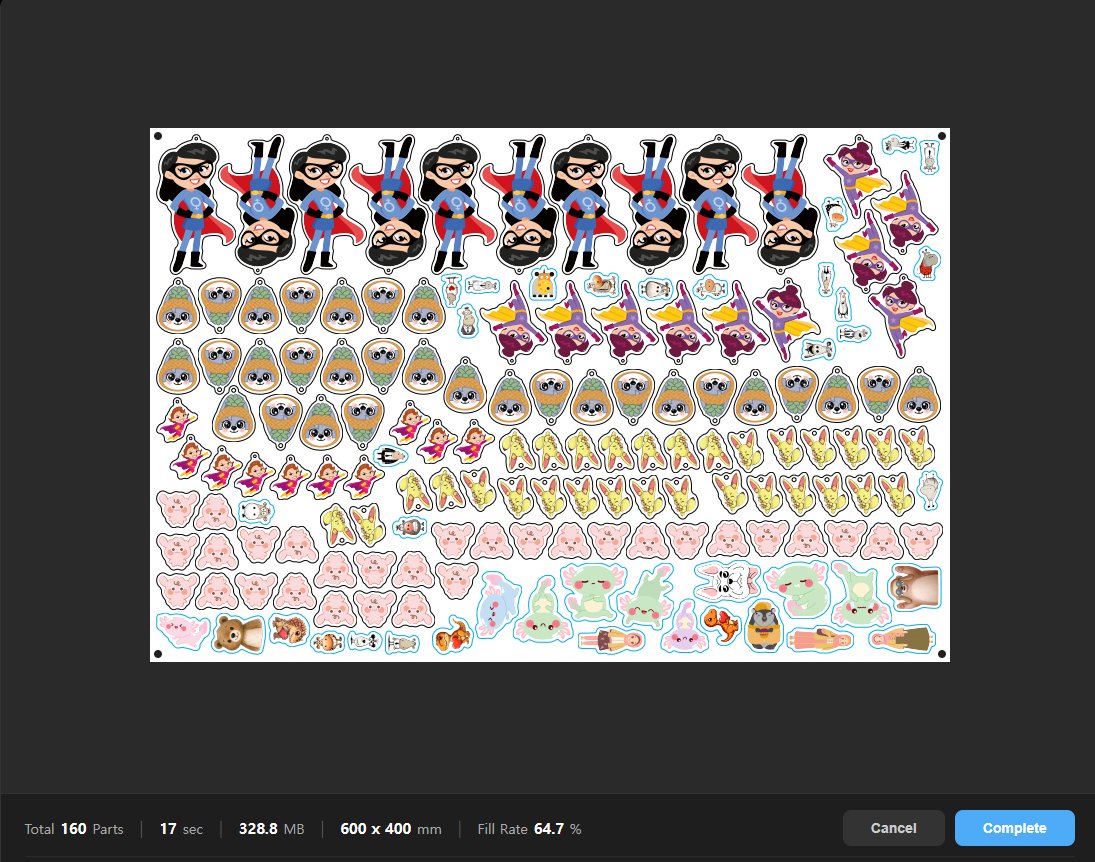
- 160 parts — multiple designs auto-grouped by order quantity, leftover space gap-filled
- 64.7% fill rate — material utilization with grouping preserved; the inter-part cut gap counts as unfilled, so this is a conservative figure
- 17 seconds — total processing time on an i9-14900K
- 600×400mm — standard sheet size
A layout that ignored grouping entirely could push the fill rate higher — but every customer's parts would be scattered across the sheet, and someone would have to sort them by hand after cutting. The figure above is the density you get while keeping the sheet sortable, which is the number that matters in production.
What this is — and what it isn't
It's worth being precise, because the overstated version is easy to disprove:
- PB does not out-pack a tool that ignores grouping. If your only goal is the absolute maximum number of parts on a sheet and you don't care how they're sorted afterward, free true-shape nesting with no groups will match or beat any grouped layout. The degrees-of-freedom result applies to PB too — grouping always has a ceiling.
- What PB removes is the tradeoff. Conventional workflows force a choice between density and sorting. PB delivers sorting-preserving groups and fills the gaps, automatically, with no manual selection.
- The gain is shape-dependent. A sheet of deeply concave shapes leaves more unavoidable waste than a sheet of compact ones, grouped or not. PB doesn't repeal geometry — it stops you from leaving the recoverable space empty.
Why sorting is worth paying for
For a one-to-five-person shop processing dozens of orders a day, the cost that actually hurts usually isn't a few percent of material — it's labour. A maximally dense sheet with every order's parts scattered turns post-cut sorting into a manual hunt. A grouped sheet comes off the cutter already organized by order.
This is the production reality that density-only benchmarks tend to ignore. The right objective isn't "maximum parts per sheet" — it's "lowest total cost per order, including the human time to sort, pack, and ship." Grouping with gap-fill optimizes the second number, which is the one a shop owner actually pays.
The takeaway
Grouping identical parts for sorting costs density. That's envelope waste plus lost degrees of freedom, and it's real — not a vendor's excuse. The mistake is treating that cost as a reason to abandon grouping entirely.
PB keeps the grouping, drives it automatically from order quantities, and fills the surrounding gaps with individual parts so the density cost is largely recovered. The result is sortable sheets without hand-imposing and without hand-sorting — which, for a busy shop, is the version of "efficient" that pays the bills.
References
- Leao, Toledo, Oliveira, Carravilla & Gomes — Two-dimensional irregular packing problems: a review (on envelope-polygon waste and inner-fit-polygon hole filling).
- Elkeran, A. (2013) — A new approach for sheet nesting problem using guided cuckoo search and pairwise clustering, European Journal of Operational Research (on density-improving complementary clustering).
Pressria Bridge is a Windows desktop application that automates print production workflows including nesting, cut line generation, and Illustrator integration. Free trial available at pb.pressria.com.